
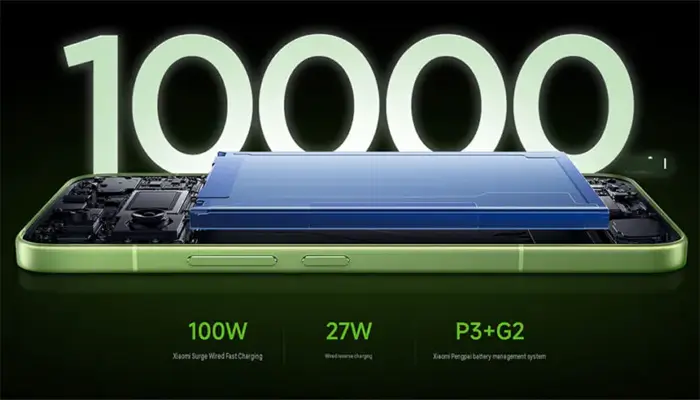
Xiaomi’s Redmi K100 brings a massive 10,000mAh silicon-carbon battery, 100W fast charging and flagship-class specifications to the Chinese market. Its launch raises a pressing question: why are Samsung and Google still relying on much smaller batteries in their premium smartphones?
A smartphone can have a brilliant camera, a stunning display and enough processing power to handle almost anything. But when its battery runs low before the day is over, those impressive features quickly become less useful. Xiaomi appears ready to challenge that familiar frustration with its latest phone, and its biggest selling point is something Samsung and Google have yet to match: a 10,000mAh battery.
The Chinese manufacturer has launched the Redmi K100 in China, bringing a substantial leap in battery capacity to a market where endurance is becoming an increasingly important selling point. Priced from 3,499 yuan, approximately $525, the device combines a silicon-carbon battery with 100W fast charging, highlighting how quickly smartphone battery technology is evolving.
For years, manufacturers focused heavily on camera megapixels, display quality and processor performance to distinguish their devices. Battery capacity, however, is emerging as another major battleground. The growing adoption of silicon-carbon battery technology is helping smartphone makers fit larger energy reserves into devices without relying entirely on conventional lithium-ion designs.
The Redmi K100 illustrates that shift. Its 10,000mAh battery is roughly twice the capacity of the 5,000mAh batteries found in several premium Samsung phones. While battery capacity alone does not determine real-world endurance, the difference is significant on paper and could translate into longer periods between charges, depending on usage and software efficiency.
Samsung and Google, meanwhile, have taken a more conservative approach. The Samsung Galaxy S26 Ultra reportedly features a 5,000mAh lithium-ion battery, while the Google Pixel 11 Pro XL carries a 5,115mAh unit. Even Samsung’s Galaxy Z Fold 8 Ultra reportedly retains a 5,000mAh battery despite the company’s move toward silicon-carbon technology in its foldable lineup.
That gap raises questions about whether premium smartphones are keeping pace with consumer expectations. Buyers spending substantial amounts on flagship devices increasingly want more than fast processors and sophisticated cameras. They also expect their phones to remain usable throughout demanding days without frequent trips to a charger.
The Redmi K100 offers more than battery capacity. It features a Snapdragon 8 Elite processor, up to 16GB of RAM and 512GB of UFS 4.1 storage. Its 6.83-inch AMOLED display supports a 165Hz refresh rate and a claimed peak brightness of 3,500 nits. The rear camera system includes a 50-megapixel primary sensor and an 8-megapixel ultrawide camera, while an IP69K rating adds protection against dust and water exposure under specified test conditions.
There are still important caveats. The phone is currently available only in China, and its starting price does not guarantee comparable pricing in other markets. A global launch under Xiaomi’s POCO brand remains speculation rather than a confirmed plan. Actual battery life will also depend on screen brightness, network conditions, applications and other factors.
Nevertheless, the direction is encouraging for consumers tired of treating battery life as a compromise. If silicon-carbon technology continues to advance, larger batteries could become a realistic expectation rather than a niche selling point. For Samsung and Google, the challenge is no longer simply to make powerful phones, but to ensure those phones can keep going long after the competition has started charging.